Niacinamide Flushing Mechanisms: Nicotinic Acid Conversion & The Concentration Paradox
Few cosmeceutical actives have enjoyed greater commercial ubiquity than niacinamide (nicotinamide, Vitamin B3). Renowned for its ability to upregulate endogenous ceramide synthesis, regulate sebaceous lipids, and inhibit melanosome transfer, it is formulating chemistry's universal workhorse. Yet consumer forums remain flooded with reports of intense burning, blotchy erythema, and facial "flushing" attributed to combining niacinamide with direct acids. Explore the molecular kinetics of amide bond hydrolysis, the GPR109A receptor cascade, and why marketing-driven 10% to 20% formulations are inducing widespread barrier disruption.
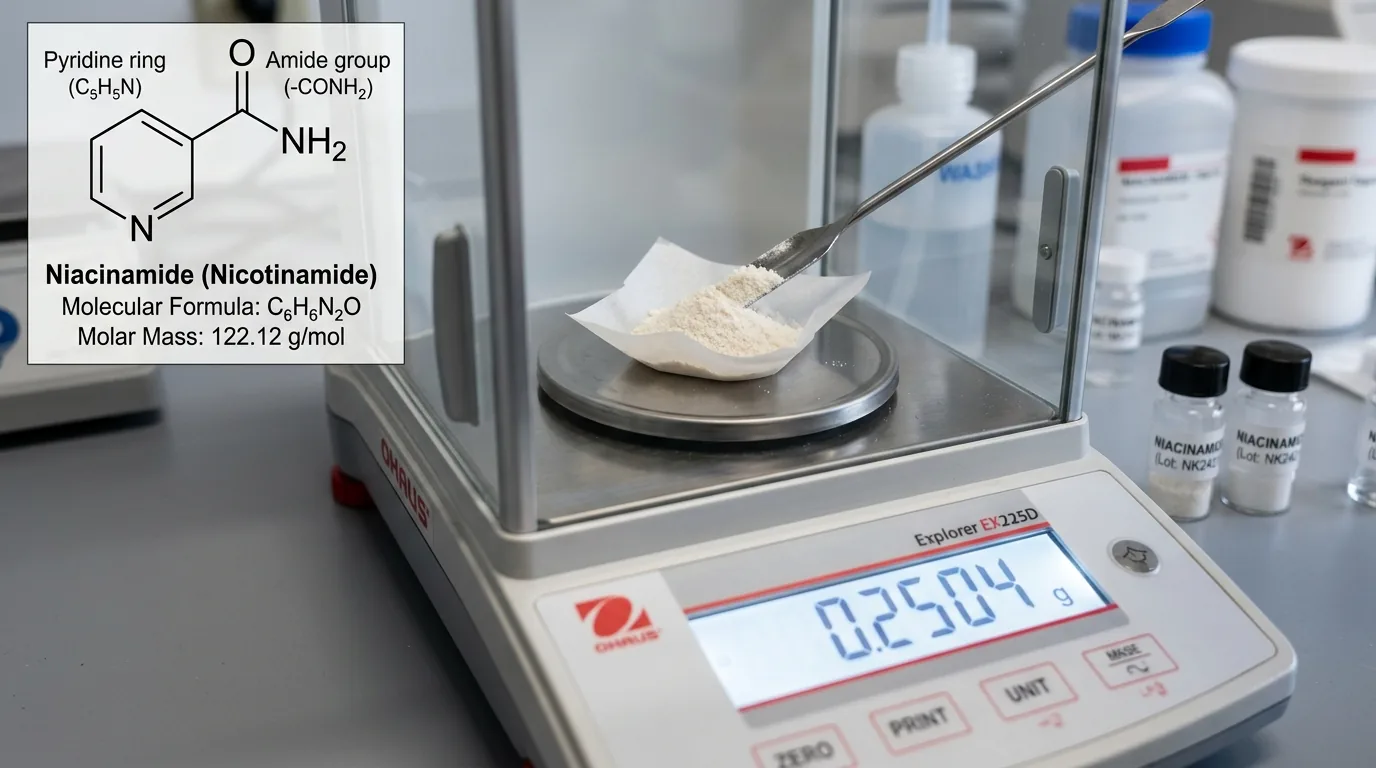
1. Chemical Differentiation: Niacinamide vs. Nicotinic Acid
The cosmetic confusion surrounding flushing stems from failing to distinguish between two distinct vitamers of Vitamin B3:
Niacinamide (Nicotinamide)
- Structure: Pyridine-3-carboxamide (molecular formula: C₆H₆N₂O, MW 122.12 Da).
- Functional Group: Neutral amide (-CONH₂) group attached at position 3 of the pyridine ring.
- Physiological Charge: Electrically neutral zwitterion at skin surface pH (4.5–6.0).
- Receptor Binding: Completely fails to bind the cutaneous vascular flushing receptor GPR109A.
Nicotinic Acid (Niacin)
- Structure: Pyridine-3-carboxylic acid (molecular formula: C₆H₅NO₂, MW 123.11 Da).
- Functional Group: Ionizable carboxylic acid (-COOH) group.
- Physiological Charge: Anionic carboxylate (-COO⁻) at physiological pH.
- Receptor Binding: Potent full agonist of the GPR109A (HCA2) receptor, triggering massive vascular flushing.
While both molecules are metabolized intracellularly by human cells into the critical redox coenzymes Nicotinamide Adenine Dinucleotide (NAD⁺ and NADH), only free nicotinic acid possesses the precise steric and electrostatic profile required to trigger microvascular dilation.
2. The Receptor Cascade: How Nicotinic Acid Induces Prostaglandin Vasodilation
The cutaneous "niacin flush" is not an allergic reaction or random irritation; it is an exquisitely mapped pharmacological neuro-vascular cascade:
- GPR109A (HCA2) Receptor Engagement: Free nicotinic acid docks onto the G-protein coupled receptor GPR109A (Hydroxycarboxylic Acid Receptor 2), which is abundantly expressed on epidermal Langerhans cells and basal keratinocytes. In knock-out mice lacking the GPR109A gene, administering massive doses of niacin fails to elicit any cutaneous erythema.
- Cytosolic Phospholipase A2 Activation: GPR109A signaling provokes an immediate influx of intracellular calcium (Ca²⁺), stimulating cytosolic phospholipase A2 (cPLA2). Activated cPLA2 cleaves membrane phospholipids, liberating free arachidonic acid.
- Prostaglandin Synthesis: Cyclooxygenase-1 (COX-1) enzymes within Langerhans cells rapidly metabolize arachidonic acid into Prostaglandin D2 (PGD2) and Prostaglandin E2 (PGE2). Simultaneously, keratinocyte COX-2 pathways sustain prolonged PGE2 production.
- Vascular Smooth Muscle Relaxation: PGD2 and PGE2 diffuse into the papillary dermis and bind specifically to DP1 and EP2/EP4 prostanoid receptors on vascular smooth muscle cells surrounding subpapillary microcapillaries. This causes instantaneous vascular relaxation, engorging the capillary beds with arterial blood and producing dramatic erythema, radiant warmth, and prickling sensations.
3. The Hydrolysis Kinetics Myth: Can Skincare Acids Convert Niacinamide?
One of the most persistent dogmas across cosmetic internet communities is that layering a Vitamin C serum (pure L-ascorbic acid at pH 3.0) with a niacinamide serum converts the niacinamide into nicotinic acid, inducing a painful flush.
In physical organic chemistry, the amide functional group is notoriously stable. Hydrolyzing an aromatic carboxamide into a carboxylic acid requires overcoming a massive thermodynamic activation energy barrier:
C₆H₆N₂O (Niacinamide) + H₂O + H⁺ → C₆H₅NO₂ (Nicotinic Acid) + NH₄⁺
In laboratory kinetics studies, achieving even a 10% conversion of nicotinamide to nicotinic acid requires boiling the solution in concentrated hydrochloric acid (pH < 1.5) at temperatures exceeding 80°C to 120°C for several uninterrupted hours.
At ambient room temperatures (20°C–25°C) and mild cosmetic acid pH levels (pH 3.0 to 3.8), the pseudo-first-order rate constant of amide hydrolysis is virtually zero. Over the course of 30 seconds to 5 minutes on facial skin, less than 0.001% of applied niacinamide could theoretically hydrolyze—an amount thousands of times below the threshold required to activate GPR109A receptors.
What About the 1:1 Niacinamide-Ascorbate Complex?
When high concentrations of L-Ascorbic Acid and Niacinamide are mixed in an aqueous solution, the partially ionized ascorbate anion and the heterocyclic pyridine ring form a 1:1 hydrogen-bonded charge-transfer zwitterionic complex. This non-covalent association often exhibits a pale yellow coloration.
However, this complex is completely reversible in water. As soon as the serum spreads across the skin and encounters cutaneous hydration, the complex readily dissociates back into free L-ascorbic acid and free niacinamide, allowing both molecules to penetrate independently. For optimal antioxidant stabilization guidelines, reference our guide on L-Ascorbic Acid Stabilization & pH Windows.
4. The Concentration Paradox: Why 2%–5% Heals While 10%–20% Burns
If chemical conversion to nicotinic acid is impossible under normal use, why do so many consumers experience redness, stinging, and burning when applying modern commercial niacinamide serums?
The culprit is marketing-driven overconcentration:
| Concentration Tier | Cutaneous Biological Action | Tolerability & Clinical Outcome |
|---|---|---|
| 2.0% – 3.0% Niacinamide | Upregulates serine palmitoyltransferase; boosts endogenous ceramide synthesis by 34%–67%; enhances filaggrin. | Optimal tolerability; reinforces barrier against retinoid flaking. |
| 4.0% – 5.0% Niacinamide | Downregulates sebum secretion rate; inhibits melanosome transfer from melanocytes by 68%; clears acne lesions. | Therapeutic Gold Standard; maximum clinical efficacy across all peer-reviewed RCTs. |
| 10.0% – 20.0% Niacinamide | Exceeds physiological receptor saturation; massive osmotic shock to epidermal corneocytes; disrupts lipid packing. | Frequent Contact Irritant Dermatitis; stinging, micro-papules, and "pseudo-flushing." |
When cosmetic brands escalate active concentrations to 10% or 20%, they provide zero additional biochemical benefit—the enzymatic pathways of ceramide synthesis and melanosome suppression are already fully saturated at 5%. Instead, the excessive molecular density creates hyperosmotic stress on fragile epidermal cells. This triggers localized keratinocyte release of inflammatory cytokines (IL-1α), mimicking the appearance of a flush through classic irritant contact dermatitis.
To understand how molecular size and formula concentration dictate dermal tolerance, explore The Molecular Weight Hierarchy of Topical Actives and examine peptide compatibility in Copper Peptides vs. Direct Acids: Denaturing Rules.
Frequently Asked Questions: Niacinamide Chemistry
Does mixing Niacinamide with Vitamin C cause facial flushing?
No. The widespread belief that layering pure L-ascorbic acid (pH 3.0 to 3.5) with niacinamide hydrolyzes the amide bond into flushing-inducing nicotinic acid is chemically unfounded. Converting niacinamide into nicotinic acid requires extreme acid environments (pH < 2.0) sustained at boiling temperatures (>80°C to 120°C) for several hours. Under ambient room temperatures on human skin, hydrolysis is kinetically negligible.
Why do 10% and 20% niacinamide serums cause redness and stinging?
The physiological "sweet spot" for topical niacinamide is 2% to 5%, which fully saturates ceramide synthesis, sebum reduction, and melanosome transfer inhibition. Concentrations of 10% to 20% dramatically increase osmotic pressure across the stratum corneum, dehydrating corneocytes and triggering non-specific contact irritant dermatitis and pseudo-flushing rather than true pharmacological receptor vasodilation.
What is the biological mechanism behind the true 'niacin flush'?
True cutaneous flushing is triggered exclusively by free nicotinic acid (niacin), not niacinamide. Nicotinic acid binds to GPR109A (HCA2) receptors on epidermal Langerhans cells and keratinocytes. This triggers cytosolic phospholipase A2 (cPLA2) activation, releasing arachidonic acid to synthesize Prostaglandin D2 (PGD2) and Prostaglandin E2 (PGE2), which bind DP1 and EP2/EP4 vascular receptors to induce intense microcapillary vasodilation.
What is the yellow color that forms when mixing Niacinamide and L-Ascorbic Acid?
When equimolar solutions of niacinamide and L-ascorbic acid are combined in water, they form a 1:1 non-covalent, charge-transfer zwitterionic salt known as the niacinamide-ascorbate complex. This complex produces a distinct light-yellow tint. The bond is completely reversible in aqueous solution and readily dissociates upon skin contact, allowing both molecules to deliver their respective biological benefits.