Hyaluronic Acid Crosslinking Technologies in Dermal Fillers: Rheology, Chemistry & Longevity
Hyaluronic acid (HA) is the undeniable gold standard in soft-tissue augmentation. Yet native, un-crosslinked HA injected into cutaneous tissue disappears within 24 to 48 hours—scavenged by endogenous hyaluronidases and reactive oxygen species. Transforming a water-soluble linear glycosaminoglycan into a resilient hydrogel capable of surviving 18 months of muscular shear stress requires precise macromolecular engineering: ether-bond crosslinking, modification degree control, and rheological tuning. Unpack the polymer chemistry governing modern cosmetic fillers.
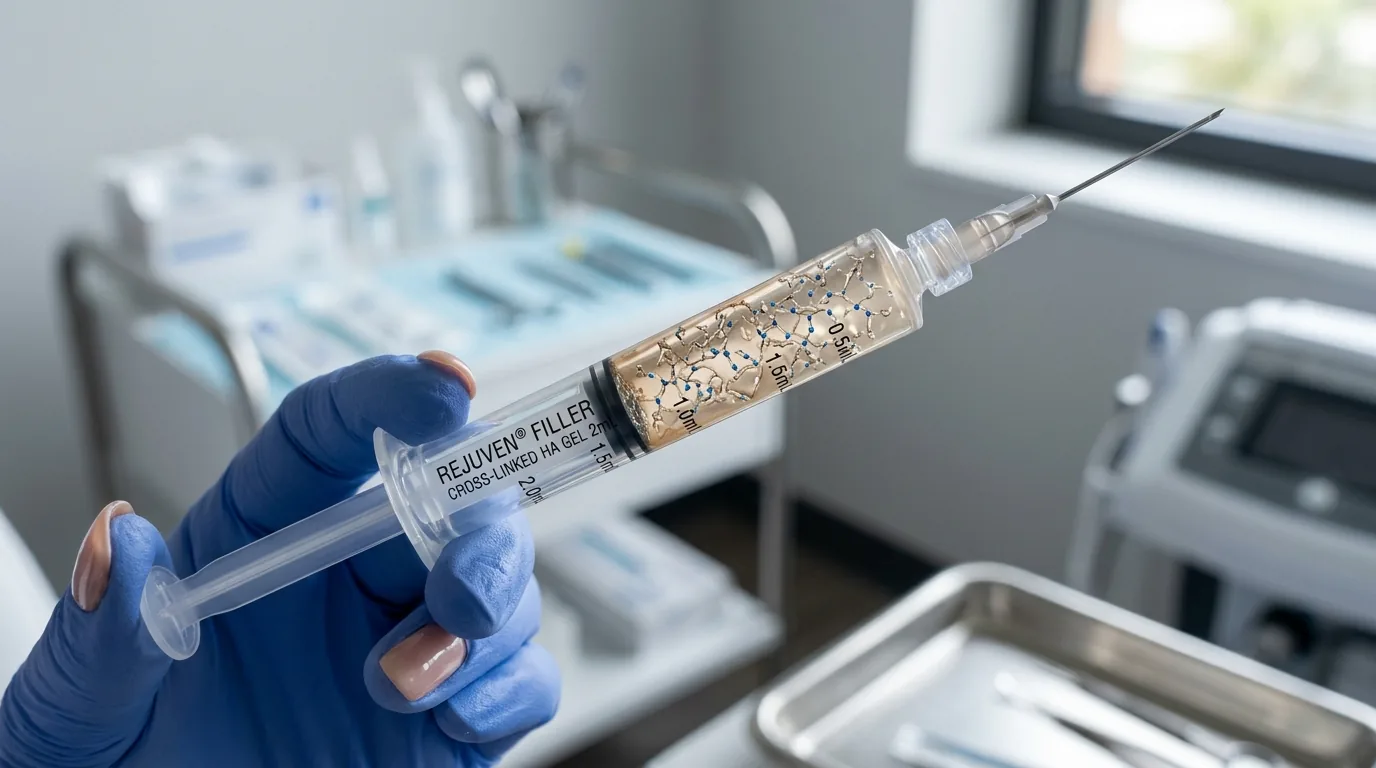
1. Polymer Chemistry: Why Native HA Vanishes & How BDDE Bridges Are Forged
Hyaluronic acid is an anionic, non-sulfated glycosaminoglycan composed of repeating disaccharide units of D-glucuronic acid and N-acetyl-D-glucosamine joined by alternating β-(1→4) and β-(1→3) glycosidic bonds. In human skin, approximately one-third of total body HA turns over daily. The physiological half-life of native HA in the dermis is less than 48 hours, driven by the rapid scission activity of hyaluronidase-1 (HYAL1) and hyaluronidase-2 (HYAL2) enzymes, along with non-specific cleavage by superoxides and hydroxyl free radicals.
To confer clinical longevity, chemical engineers bridge adjacent polymer strands using bifunctional crosslinking agents. Across 95% of FDA-approved dermal fillers, the universal industrial reagent of choice is 1,4-butanediol diglycidyl ether (BDDE):
Under alkaline conditions (typically pH > 11 using sodium hydroxide), the hydroxyl (-OH) groups of hyaluronic acid—predominantly at the C6 carbon of N-acetylglucosamine—undergo deprotonation to form reactive alkoxide nucleophiles.
The terminal epoxide rings of the bifunctional BDDE molecule undergo ring-opening nucleophilic substitution. Each BDDE molecule covalently tethers between two opposing HA polymer backbones, generating a chemically robust bis-ether aliphatic bridge (HA-O-CH2-CH(OH)-CH2-O-(CH2)4-O-CH2-CH(OH)-CH2-O-HA).
Degree of Modification (MoD) & The <2 ppm Safety Mandate
During synthesis, not every BDDE molecule forms a successful inter-chain crosslink. A portion reacts at only one end, leaving an open pendant epoxide that subsequently hydrolyzes into an inactive mono-linked diol. The Modification Degree (MoD) represents the stoichiometric percentage of HA disaccharide monomers carrying a chemically bonded BDDE residue (typically between 1% and 10% in commercial products).
While free, unreacted monomeric BDDE is an epoxide with theoretical mutagenic potential, finished commercial hydrogels undergo intensive aqueous washing, membrane dialysis, and autoclave cycles. Global regulatory bodies—including the United States FDA and European CE authorities—mandate that residual free BDDE in the commercial syringe must measure strictly less than 2 parts per million (<2 ppm, or <0.002 mg/mL). In commercial testing, levels routinely measure below 0.2 ppm, establishing complete biological safety and hypoallergenic biocompatibility.
2. Dermal Filler Rheology: Demystifying G', G'', Tan Delta & Cohesivity
Injectable hyaluronic acid hydrogels are neither simple liquids nor rigid solids; they are viscoelastic materials that simultaneously store and dissipate mechanical energy. Predicting how a filler behaves under the skin requires mastering four fundamental rheological metrics:
Elastic Modulus (G') — "Firmness & Lift"
Measured in Pascals (Pa). G' quantifies the elastic energy stored within the hydrogel network during oscillatory shear deformation.
Clinical Reality: High G' gels (600–1,200 Pa) resist mechanical compression from facial muscles and gravity. They provide structural projection, crisp contouring, and bony anchorage along the zygoma, chin, and mandibular angle.
Loss Factor (Tan δ) — "Flexibility"
The ratio of viscous modulus to elastic modulus: tan δ = G'' / G'.
Clinical Reality: Tan δ values below 0.1 denote rigid, highly elastic gels. Higher tan δ values (0.2–0.5) denote flexible, compliant gels engineered to deform fluidly with natural smiling, chewing, and perioral speech articulation without creating unnatural bulges.
Complex Viscosity (η*) — "Extrusion Drag"
The total resistance to flow under dynamic stress, measured in Pascal-seconds (Pa·s).
Clinical Reality: Fillers exhibit shear-thinning (pseudoplastic) properties: under high extrusion force in a narrow 30G needle, viscosity plummets, allowing smooth injection; once placed into resting tissue, viscosity rebounds to keep the product anchored.
Cohesivity (Gavard-Sundaram Scale)
Measures the internal affinity holding the gel mass together against spreading, rated from 1 (fully dispersed) to 5 (fully cohesive).
Clinical Reality: High cohesivity prevents filler migration into adjacent tissue planes. Highly cohesive gels integrate uniformly in superficial, mobile anatomical zones without bead formation.
3. The Proprietary Platforms: NASHA vs. Hylacross vs. Vycross vs. XpresHAn vs. CPM
Every major pharmaceutical aesthetic manufacturer employs proprietary polymerization and sieving techniques to impart distinct mechanical personalities into their syringes:
| Technology | Representative Brands | Polymer Architecture | Rheological Trait | Ideal Clinical Deployment |
|---|---|---|---|---|
| NASHA (Galderma) | Restylane Lyft, Classic | Minimal crosslinking (~1%), chain entanglement, sieved calibrated particles | Ultra-high G', low cohesivity | Deep supraperiosteal bone boluses, pyriform aperture, high cheek projection |
| Hylacross (Allergan) | Juvéderm Ultra, Ultra Plus | 100% High Molecular Weight HA, fully crosslinked monophasic matrix | High G', high viscosity, significant hydrophilic swelling | Deep nasolabial folds, dramatic lip volumization, thick dermal layers |
| Vycross (Allergan) | Voluma, Volux, Vollure, Volbella | Engineered blend of 90% Low MW HA + 10% High MW HA; dense crosslinking | High crosslinking efficiency, minimal water swelling, extended longevity | Voluma for zygoma/chin; Volux for jawline; Volbella for subtle perioral lines |
| XpresHAn / OBT (Galderma) | Restylane Defyne, Refyne, Kysse | Variable crosslink densities designed for dynamic stretch and elastic recovery | Balanced G' with high tan δ (maximum dynamic flexibility) | Dynamic lip motion (Kysse), animated nasolabial/marionette smile lines |
| CPM (Merz) | Belotero Balance, Intense, Soft | Cohesive Polydensified Matrix; two-step crosslinking yielding variable density zones | Monophasic polydensified; zero particle scatter (no Tyndall) | Superficial etching (blanching technique), tear troughs, radial lip lines |
Understanding these rheological distinctions prevents clinical misplacement: injecting a rigid, low-cohesivity NASHA particulate into the dynamic wet-dry lip border or thin infraorbital tear trough produces visible, lumpy bluish discoloration (the Tyndall effect). Conversely, placing a soft, low-G' CPM hydrogel onto the zygomatic bone fails to deliver structural cheek projection.
4. Enzymatic Dissolution Kinetics: The Hyaluronidase Reversal Protocol
The defining clinical virtue of hyaluronic acid fillers is absolute, emergency reversibility via exogenous hyaluronidase. Hyaluronidase hydrolyzes the β-(1→4) linkages between N-acetylglucosamine and glucuronic acid, disintegrating the 3D hydrogel into harmless low-molecular-weight tetrasaccharides and disaccharides that are cleared through the lymphatic circulation within hours.
However, dissolution kinetics differ substantially depending upon crosslinking chemistry:
- NASHA Fillers (Restylane Classic / Lyft): Due to their low degree of chemical modification (~1%) and particulate architecture, the glycosidic backbone remains highly accessible to enzyme binding. They dissolve rapidly with standard hyaluronidase concentrations (15 to 30 units per nodule).
- Vycross Fillers (Juvéderm Voluma / Volux): The tight 90:10 LMW-to-HMW crosslinking creates dense steric hindrance, shielding the inner glycosidic bonds from enzymatic docking. Dissolving Vycross nodules requires significantly higher doses (100 to 300+ units of hyaluronidase) and repeated mechanical massage.
- Vascular Occlusion Emergencies: If intra-arterial embolization occurs—threatening dermal necrosis or retrobulbar ophthalmic blindness—clinicians initiate high-dose pulsed hyaluronidase protocols (500 to 1,500+ units flooded every 60 minutes across the ischemic watershed) until capillary refill normalizes.
To explore how injectables interact with neurotoxin longevity and trace mineral bio-availability, consult our guide on Botox Longevity & Zinc Bio-availability, and discover how molecular mass dictates transdermal delivery in The Molecular Weight Hierarchy of Topical Actives.
Frequently Asked Questions: Dermal Filler Crosslinking
Why is chemical crosslinking necessary for hyaluronic acid dermal fillers?
Native, un-crosslinked hyaluronic acid has an in-vivo half-life of only 24 to 48 hours in human skin. It is rapidly degraded through hydrolytic cleavage by endogenous hyaluronidase enzymes (HYAL1 and HYAL2) and free radical oxidation. Chemical crosslinking with bifunctional crosslinkers like 1,4-butanediol diglycidyl ether (BDDE) creates permanent covalent ether bonds between polysaccharide chains, shielding the polymer backbone from enzymatic access and extending clinical longevity to 6 to 24 months.
Is BDDE crosslinker toxic or dangerous in cosmetic injectables?
While unreacted, free BDDE epoxide is mutagenic in industrial quantities, medical device manufacturing protocols subject crosslinked gels to exhaustive dialysis and washing cycles. Global regulatory standards, including the United States FDA, mandate that residual unreacted BDDE must be less than 2 parts per million (<2 ppm or <0.002 mg/mL) in the finished syringe, a concentration conclusively proven to be non-toxic, non-sensitizing, and physiologically inert.
What is the clinical difference between filler G-Prime and Cohesivity?
Elastic shear modulus (G') measures the gel's firmness and capacity to resist dynamic mechanical shearing forces, delivering structural lifting and lateral projection over bony landmarks like the zygoma or mandibular angle. In contrast, cohesivity (measured on the Gavard-Sundaram scale) reflects internal intermolecular adhesion—how strongly the gel clings to itself without fragmenting under tissue pressure, allowing smooth, lump-free tissue integration in mobile zones like the lips and tear troughs.
How does hyaluronidase dissolve different crosslinked fillers?
Exogenous bovine or recombinant human hyaluronidase breaks the beta-1,4-glycosidic linkages in the hyaluronic acid backbone. Fillers with lower modification degrees (MoD) and particulate structures (such as NASHA / Restylane) degrade rapidly upon exposure. Densely crosslinked matrices with low molecular weight blends (such as Vycross / Voluma) exhibit tighter steric hindrance, requiring higher enzyme units and repetitive dosing to achieve complete dissolution.