The Met Gala Dermal Prep Timeline: 6 Months to 24 Hours Pre-Event
The seemingly poreless, sculpted, and light-reflective complexions on the Metropolitan Museum steps are not the product of a single facial or emergency primer. Behind every iconic gala appearance is an intricate six-month biological countdown choreographed by aesthetic physicians and cosmetic chemists. Here is how master clinicians orchestrate biostimulators, high-intensity energy devices, neuromodulators, and osmotic drainage along an unyielding wound-healing schedule.
The Core Chronobiology of Red-Carpet Aesthetic Staging
- 1. 6 Months Out (Biostimulation): Poly-L-Lactic Acid (Sculptra) and Calcium Hydroxylapatite (Radiesse) trigger deep fibroblastic collagenesis over 120–180 days, restoring structural bone and deep dermal volume without pillowing.
- 2. 3 to 4 Months Out (Thermal Remodeling): Fractional radiofrequency microneedling and micro-focused ultrasound contract the SMAS and deep dermis, requiring 12 weeks for collagen cross-linking and full dermal remodeling.
- 3. 3 to 4 Weeks Out (Neuromuscular & HA Lock): Neuromodulators achieve stable motor endplate blockade with natural movement; crosslinked HA fillers settle hydrophilic water retention and clear hematoma risks.
- 4. Final 72 Hours (Osmotic Mobilization Only): Absolute ban on trauma, needles, lasers, and medium peels. Strictly non-invasive manual lymphatic drainage and cold cryo vasoconstriction to carve bone structure.
1. The Biological Clock of Aesthetic Dermatology: Tissue Healing Kinetics
In consumer beauty media, cosmetic procedures are often portrayed as immediate transformations: an injection or a laser sweep performed on Thursday for a Friday red carpet. In biological reality, human tissue operates on rigid physiologic timelines dictated by the inflammatory cascade, fibroblast migration, angiogenesis, and collagen maturation.
When an aesthetic provider introduces mechanical trauma (microneedles), thermal coagulation (lasers or radiofrequency), or chemical biostimulation (PLLA microspheres), the dermis initiates a sequential four-phase wound-healing cascade:
Neutrophil and macrophage infiltration, cytokine release (IL-1, TNF-alpha), capillary dilation, and interstitial edema. If photographed now, skin exhibits swelling and erratic light reflection.
Granulation tissue synthesis, provisional Type III collagen deposition, endothelial cell budding. High susceptibility to hyper-reactivity, transient redness, and foundation breakdown.
Replacement of delicate Type III collagen by tensile Type I collagen bundles. Gradual tissue contraction and architectural dermal thickening.
Maximal tensile strength, optimal dermal-epidermal junction cohesion, and stabilized tissue architecture. This is the physiological state required for flawless high-definition scrutiny.
Attempting to compress this biological clock into a two-week rush creates the classic Hollywood "overfilled, bruised, and puffy" appearance. True red-carpet excellence begins six months out.
2. Month 6 to 4: Deep Structural Biostimulation (PLLA, CaHA & Neocollagenesis)
Six months prior to the first Monday in May, the focus is entirely structural. Rather than creating immediate artificial volume with thick hyaluronic acid gels—which can cause unwanted fluid retention and distort natural facial dynamics—elite injectors turn to biostimulatory injectables: Poly-L-Lactic Acid (Sculptra) and Calcium Hydroxylapatite (Radiesse).
As detailed in clinical reviews on stimulatory dermal fillers (Lacombe, PMID 19415576), microparticles of PLLA do not act as static volumetric implants. Instead, they induce a controlled subclinical foreign-body response, stimulating macrophages, mast cells, and lymphocytes to recruit fibroblasts. Over 8 to 24 weeks, the PLLA degrades into lactic acid monomers via non-enzymatic hydrolysis while newly recruited fibroblasts deposit a dense scaffolding of host collagen.
A patient treated with Sculptra or hyper-dilute Radiesse at Month 6 will experience peak Type I collagen deposition precisely during the gala week. Furthermore, scheduling biostimulators early provides a safe temporal cushion: any rare late-onset granuloma or micro-nodule can be clinically managed and resolved months before cameras fire.
3. Month 4 to 3: High-Intensity Thermal Remodeling (RF Microneedling & Ultrasound)
With deep structural collagenesis underway, the calendar shifts to mid-dermal and sub-SMAS tissue tightening. The window between 12 and 16 weeks pre-event is the designated window for high-intensity energy devices: Radiofrequency (RF) Microneedling (such as Morpheus8, Lutronic Genius, or Potenza) and Micro-Focused Ultrasound (Ultherapy or Sofwave).
In a comprehensive clinical analysis of radiofrequency microneedling mechanisms (Weiner, PMID 33577211), insulated or semi-insulated needles deliver fractional thermal coagulation zones at temperatures exceeding 65°C directly into the reticular dermis. This instantaneous thermal denaturation of collagen fibrils initiates an immediate wound contraction, followed by prolonged elastin and collagen synthesis continuing for up to six months.
Why must RF microneedling be performed at least 90 days out? Deep passes (3.0mm to 4.0mm) routinely cause persistent subclinical edema, track marks, pinpoint purpura, and transient subcutaneous firmness that can take 4 to 8 weeks to soften completely. By month 3, the skin has cleared all textural track marks and exhibits genuine architectural firming along the mandibular border and submentum.
4. Weeks 8 to 6: Vascular Quenching & Photofacial Clearance (532/595nm & 1927nm)
Two months before the red carpet, aesthetic strategy turns from structural remodeling to chromatic perfection. HD broadcast cameras detect trace dyschromia—residual post-acne erythema, telangiectasias around the nasal alar base, and superficial solar lentigines.
Aesthetic clinicians deploy dual-wavelength optical passes:
- Vascular Specificity: Pulsed-Dye Laser (595nm) or frequency-doubled Nd:YAG (532nm) to photocoagulate superficial dilated capillaries. This eliminates persistent facial flushing under hot venue spotlights.
- Superficial Pigment Sweep: Low-energy fractional 1927nm thulium resurfacing (detailed in our clinical review of Clear + Brilliant Perméa and Sciton MOXI) to eliminate epidermal melanin freckling and accelerate stratum corneum renewal.
As highlighted in foundational photomedicine literature (Babilas et al., PMC2921736), non-ablative fractional photothermolysis leaves microscopic necrotic debris (MENDs) that require 5 to 7 days to shed, followed by subtle vascular re-equilibration. Completing this pass 6 to 8 weeks out ensures zero lingering redness.
5. Weeks 4 to 3: Neuromodulator Precision & Volumetric Hyaluronic Acid Stabilization
The 21-to-28-day marker is the injectable sweet spot. Injecting neuromodulators (onabotulinumtoxinA, abobotulinumtoxinA, daxibotulinumtoxinA) or hyaluronic acid (HA) fillers too close to an event is the primary cause of celebrity aesthetic mishaps.
Full motor endplate denervation takes 10 to 14 days. When neuromodulators are administered four weeks in advance, the injector can perform any microscopic asymmetry touch-up at day 14. Furthermore, by day 28, the initial "stiffness" has softened into natural, animated smoothness—eliminating the dreaded frozen forehead look.
Cross-linked hyaluronic acid is highly hydrophilic, pulling water from surrounding tissue over the first two weeks post-injection. As documented in international consensus guidelines on dermal filler complications (Funt & Pavicic, PMC4404720; Signorini et al., PMC12011065), acute hematomas, lymphatic blockages, and delayed hypersensitivity reactions require immediate clinical evaluation. A four-week buffer allows full tissue integration and permits emergency hyaluronidase reversal if an aesthetic or vascular compromise occurs.
6. Weeks 2 to 1: Intradermal Micro-Infusion & Dermal Quenching
Fourteen to seven days before the event, needle depth is restricted to the upper 0.5mm—strictly within the avascular papillary dermis. This is the realm of intradermal micro-infusion (utilizing specialized gold-plated 24K micro-channel devices or stamping arrays).
Rather than injecting deep into facial mimetic musculature, micro-infusions deliver micro-droplets of a tailored cosmeceutical cocktail:
- Micro-Botox (10–15 units diluted in saline): Paralyzes the arrector pili smooth muscles and suppresses sebaceous and eccrine sweat gland secretion, visibly shrinking pore diameter and curbing shine under stadium flashbulbs.
- Non-Crosslinked HA (Uncrosslinked, 50–200 kDa): Floods the extracellular matrix with direct hygroscopic water binding for glass-skin plumpness.
- Tranexamic Acid (1–2%): Blocks plasminogen-induced melanocyte activation, ensuring an even, luminous tone.
7. Final 72 to 24 Hours: Osmotic Mobilization, Lymphatic Clearance & Strictly No Trauma
Inside the 72-hour perimeter, the primary objective is zero cellular irritation and maximum light reflection. In-clinic interventions shift completely from tissue transformation to fluid physics:
The 72-Hour Backstage Protocol
- Manual Lymphatic Drainage (Vodder Technique): Gentle rhythmic directional strokes guide accumulated interstitial lymph toward retroauricular and cervical lymph nodes, carving the zygomatic arch and submental contour.
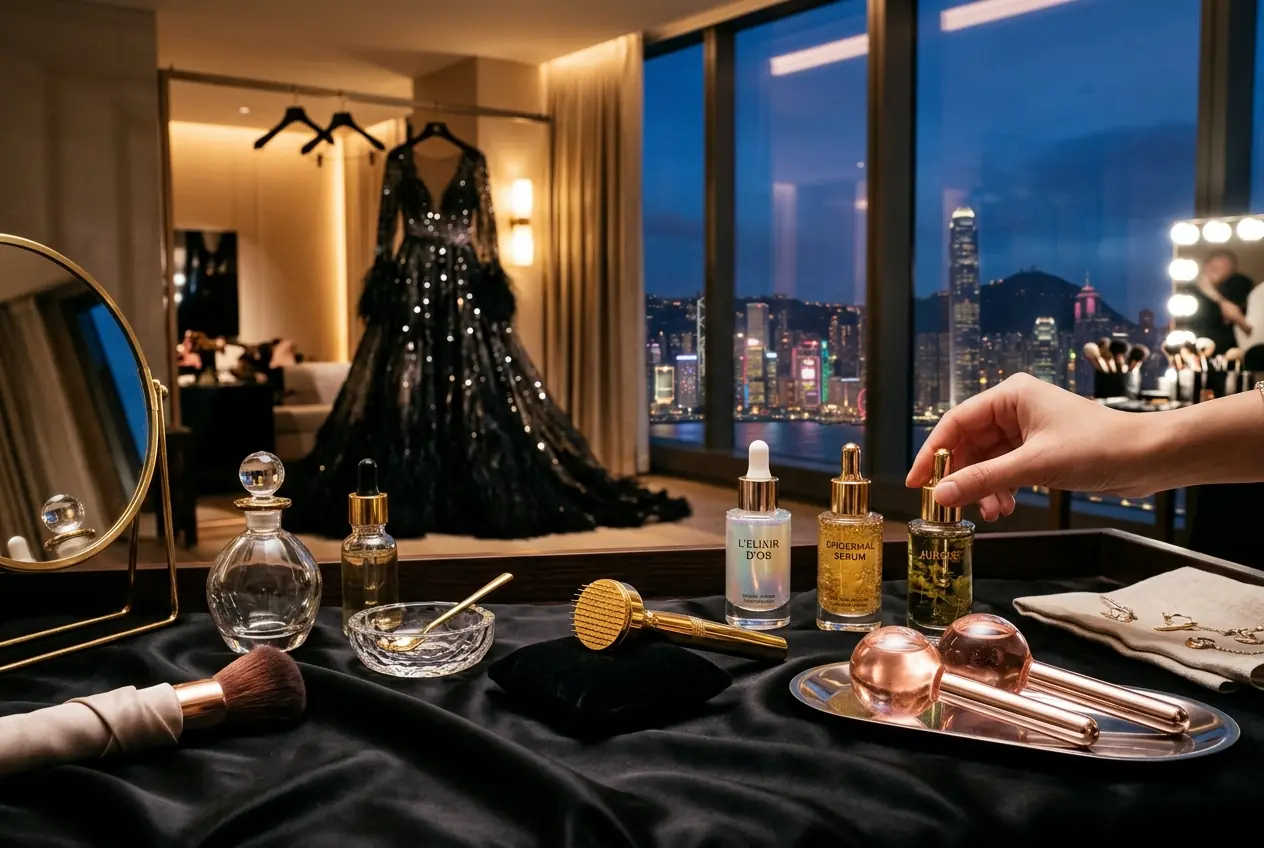
- Cryotherapy Vasoconstriction: Chilled borosilicate glass globes (4°C to 8°C) reduce capillary hyper-permeability and calm minor redness.
- Buffered Lactic Acid Glaze: High-pH (4.0) 10% L-lactic acid dissolves corneocyte cohesion without disrupting basal barrier integrity.
- 3:1:1 Equimolar Ceramide Sealing: Topical replenishment of ceramides, cholesterol, and free fatty acids to eliminate transepidermal water loss (TEWL) and ensure silicone foundation glides smoothly.
For a complete hour-by-hour operational breakdown of the final countdown, consult our core feature on The Red Carpet Skin Protocol: 72-Hour Pre-Event Peels, Micro-Infusion & Osmotic Depuffing.
Frequently Asked Questions: Met Gala Aesthetic Planning
Why do celebrities begin aesthetic prep 6 months before the Met Gala?
True dermal transformation respects biological tissue repair kinetics. Biostimulatory agents like Poly-L-Lactic Acid (PLLA) and deep radiofrequency remodeling require 3 to 6 months to trigger fibroblast recruitment, cellular proliferation, and progressive Type I and III collagen synthesis. Scheduling these treatments early builds a firm dermal foundation without visible swelling on the red carpet.
When should neuromodulators (Botox/Dysport) be injected before a major gala?
Neuromodulators should be administered precisely 3 to 4 weeks prior to the event. This window allows peak motor endplate blockade (which takes 10 to 14 days), accommodates any minor touch-up dosing, permits transient micro-bruising to clear, and prevents the stiff or unnatural frozen look by allowing facial expressions to soften naturally.
How far in advance must hyaluronic acid dermal fillers be completed?
Hyaluronic acid dermal fillers must be injected 4 to 6 weeks before the event. Hydrophilic cross-linked HA absorbs interstitial water over the first two weeks, causing transient fluctuations in volume. A 4-to-6-week buffer ensures complete tissue integration, resolution of lymphatic edema, and ample time to dissolve any asymmetric nodules with hyaluronidase if necessary.
What treatments are strictly forbidden within 7 days of an on-camera event?
Within the final 7 days, all ablative and non-ablative fractional lasers, medium-to-deep chemical peels (TCA, Jessner), deep mechanical microneedling, vascular lasers, and newly formulated topical skincare trials are strictly contraindicated due to risks of prolonged erythema, micro-crusting, and foundation incompatibility.
What can be done in the final 24 hours to maximize cheekbone definition and radiance?
The final 24 hours focus exclusively on fluid physics and stratum corneum light reflection: manual lymphatic drainage (MLD) to clear stagnant interstitial fluid toward cervical lymph nodes, cold borosilicate cryo globes (4°C) for transient vascular tone, and non-traumatic multi-molecular hyaluronic acid hydration sealed with physiological ceramides.