In-Clinic Celebrity Laser Realities: Clear + Brilliant, Moxi & Red-Carpet Downtime
Branded in Beverly Hills and Manhattan med-spas as "the lunchtime laser" and "the baby Fraxel," fractional 1927nm resurfacing promises red-carpet glow with zero downtime. But cosmetic biology tells a far more nuanced story. An aesthetic formulation chemist dissects diode vs. thulium laser physics, the microscopic shedding of necrotic debris, and why booking a session 48 hours before an awards gala is a recipe for cosmetic disaster.
Clinical Realities: The 1927nm Laser Dossier
- 1. The "Zero Downtime" Myth: Fractional photothermolysis produces microscopic thermal injury zones (MTZs). Between days 3 and 6, patients develop rough, sandpaper-textured micro-epidermal necrotic debris (MENDs) that compromises makeup finish.
- 2. Diode vs. Thulium Optics: Clear + Brilliant Perméa utilizes a fixed 1927nm diode for mild transdermal permeability enhancement, whereas Sciton MOXI harnesses a fractional thulium fiber laser with higher energy ceilings (up to 20 mJ/pulse) and programmable coverage density.
- 3. The 14-Day Event Horizon: Scheduling within 7 to 10 days of an on-camera appearance exposes entertainers to patchy desquamation, focal dry patches, and altered powder binding under 8K digital sensors.
- 4. Barrier Shielding Chemistry: Post-laser recovery demands immediate cessation of exfoliating acids and prescription retinoids, pivoting strictly to 3:1:1 equimolar ceramide matrices, ectoin cellular osmoprotectants, and non-nano zinc oxide.
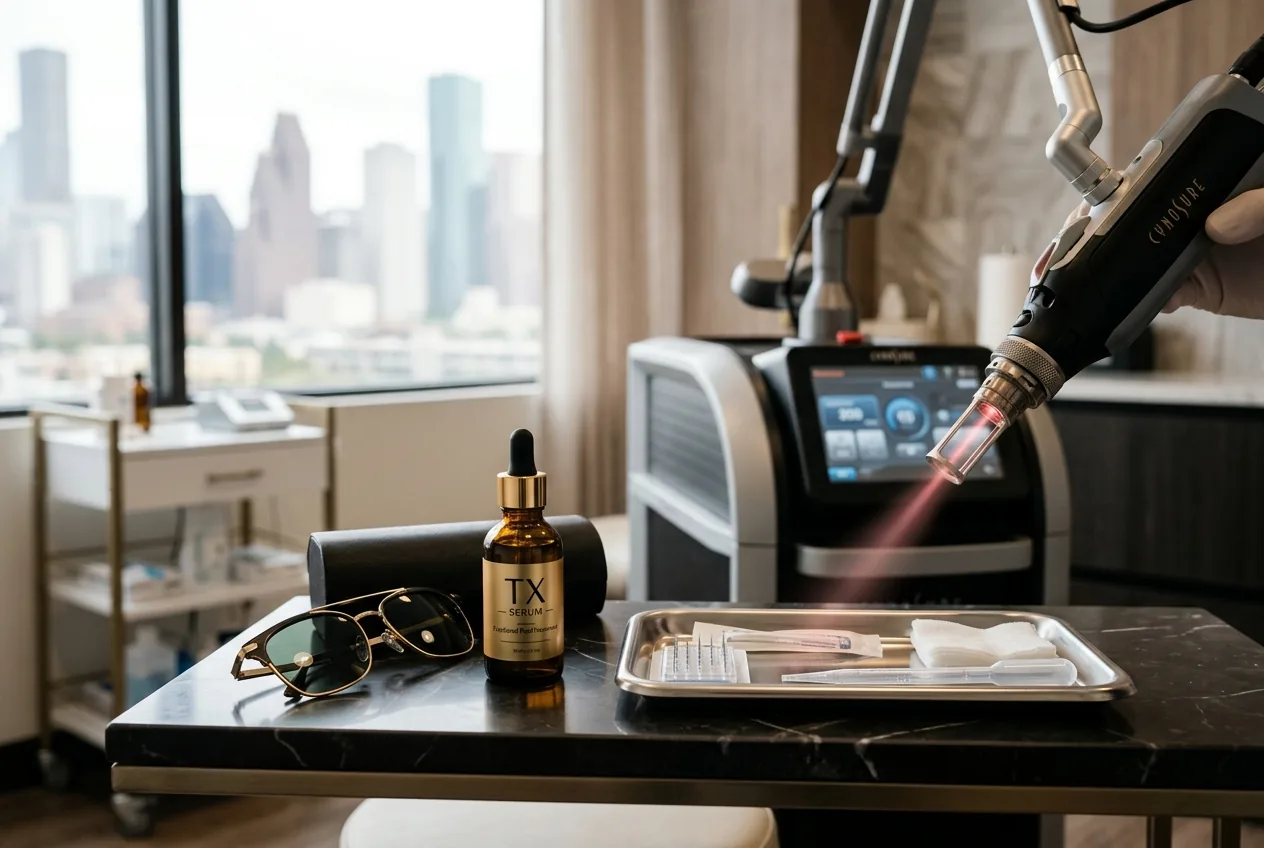
1. The Red-Carpet Laser Paradox: "Zero-Downtime" Marketing vs. Optical Physics
In celebrity aesthetic culture, laser resurfacing occupies an ambiguous space. Traditional fully ablative carbon dioxide (CO2 10,600nm) and Erbium:YAG (2940nm) lasers vaporize tissue down to the papillary or reticular dermis, generating profound neocollagenesis but requiring 14 to 28 days of oozing, crusting, and post-procedure erythema. On an entertainment production calendar, four weeks of isolation is an unaffordable luxury.
Enter the low-fluence fractional 1927nm wavelength. Heavily commercialized as Clear + Brilliant Perméa (Solta Medical) and MOXI (Sciton), these platforms are promoted to actors, models, and public figures as "weekend glow-ups" that leave the skin camera-ready by Monday morning.
However, as documented in peer-reviewed photomedicine literature (Lee et al., PMC7118506), fractional photothermolysis relies on creating columns of thermal coagulation known as Microscopic Treatment Zones (MTZs). Even when energy is calibrated to be strictly non-ablative—leaving the stratum corneum physically intact immediately post-pulse—the underlying tissue is biologically compromised. Understanding how those microscopic thermal lesions resolve is the difference between effortless red-carpet radiance and makeup that cracks under camera strobes.
2. Fractional 1927nm Wavelength Mechanics: Thulium vs. Diode Tissue Interactions
To understand why the 1927nm wavelength has become the gold standard in Hollywood pre-event maintenance, one must evaluate its absorption spectrum. Unlike vascular lasers (532nm potassium titanyl phosphate or 595nm pulsed-dye) which target oxyhemoglobin, or pigment lasers (755nm alexandrite or 1064nm Nd:YAG) which target melanin, the 1927nm wavelength targets intracellular water.
Water absorption at 1927nm is roughly ten times higher than at 1550nm (the classic Fraxel Re:store wavelength), but significantly lower than at 2940nm (Erbium). This optical sweet spot restricts thermal damage to the epidermis and the superficial papillary dermis (approximately 150 to 250 microns in depth). The result is rapid, superficial epidermal renewal without deep thermal necrosis or extensive dermal edema.
In a seminal optical study examining fractional 1927nm thulium laser-tissue interactions (Jacobsen et al., PMC12264580), researchers mapped the spectrum from non-ablative coagulation to micro-ablation. At low to moderate pulse energies, the stratum corneum acts as a natural biological dressing while keratinocytes in the stratum spinosum and basale undergo coagulative necrosis, triggering accelerated basal migration.
3. Clear + Brilliant Perméa vs. Sciton MOXI: Device Architecture & Clinical Comparison
While both devices market their prowess around the 1927nm peak, their engineering, power delivery, and clinical endpoints diverge substantially. Clinicians and formulation chemists do not view them as interchangeable commodities.
| Parameter | Clear + Brilliant Perméa | Sciton MOXI |
|---|---|---|
| Laser Medium & Source | Fractional Optical Diode (1927nm) | Fractional Thulium Fiber Laser (1927nm) |
| Pulse Energy Range | Low fixed range (approx. 5–9 mJ/pulse) | Adjustable energy tiers (up to 20 mJ/pulse) |
| Density & Coverage Control | Fixed roller tip; standardized tracking handpiece | Customizable density percentages (5% to 25%+ coverage) |
| Primary Aesthetic Endpoint | Transdermal drug/cosmeceutical permeation; mild polish | Pigment clearance; solar elastosis renewal; textural pre-juvenation |
| Tactile Sandpaper Phase | Mild; days 2 to 4 | Moderate to pronounced; days 3 to 6 |
| Typical Social Downtime | 24–48 hours of erythema; 4 days MENDs | 48–72 hours of swelling/erythema; 5–7 days MENDs |
Clear + Brilliant Perméa is explicitly engineered to increase trans-epidermal permeability. By creating thousands of microscopic perforations through the hydrophobic stratum corneum, Perméa increases the uptake of topical high-molecular-weight serums (such as ascorbic acid, tranexamic acid, or non-crosslinked hyaluronic acid) by several hundred percent immediately post-laser.
Sciton MOXI, conversely, is a true fractional thulium platform that delivers higher peak energies and variable density arrays. It is designed to target early sun damage, epidermal dyschromia, and fine lines. While MOXI produces superior visible pigment clearance in a single pass compared to Perméa, its increased thermal footprint creates denser microscopic debris and extends social downtime.
4. Micro-Epidermal Necrotic Debris (MENDs): The Biological Healing Timeline
The physiological phenomenon that completely contradicts the "zero downtime" claim is the generation of MENDs (Micro-Epidermal Necrotic Debris). When a 1927nm laser column vaporizes water within epidermal cells, it coagulates the adjacent keratinocytes and melanocytes.
The body does not reabsorb this coagulated column from beneath. Instead, the surviving viable basal keratinocytes at the margins of the MTZ rapidly proliferate and migrate inward under the lesion, re-establishing a continuous epidermal barrier within 24 to 48 hours.
Patients experience intense cutaneous heat resembling a severe sunburn, transient edema (accentuated in periorbital tissues), and uniform erythema. The stratum corneum remains intact, but barrier permeability is markedly elevated.
As new basal cells push upward, the coagulated micro-columns containing melanin pigment and cellular debris are pushed into the stratum corneum. To the naked eye, the skin appears slightly bronzed or muddy. To the touch, it feels like medium-grit sandpaper. Applying liquid foundation during this phase causes pigment to cling around microscopic debris columns, creating severe patchiness under studio lights.
The MENDs naturally shed during gentle daily cleansing. Premature scrubbing or enzymatic exfoliation during this phase tears the immature underlying stratum corneum, creating raw micro-fissures and secondary post-inflammatory hyperpigmentation.
5. Skin of Color (Fitzpatrick IV–VI) & Melasma: Mitigating Thermal PIH Risks
One of the most celebrated attributes of 1927nm fractional resurfacing is its relative safety across diverse skin tones. In darker phototypes (Fitzpatrick IV through VI), traditional ablative lasers and broad-spectrum IPL carry high risks of catastrophic post-inflammatory hyperpigmentation (PIH) and hypopigmentation due to non-specific melanin absorption.
In a dedicated pilot trial investigating 1927nm fractional thulium treatment in darker skin types (Alharbi et al., PMC8016558), low-energy, low-density settings successfully cleared recalcitrant PIH lesions with minimal adverse events, although temporary crusting and post-treatment downtime averaged 5.9 days.
However, caution is imperative in patients with active melasma. As outlined in international dermatologic consensus reviews on lasers in melasma (Sarkar et al., PMC5724305; Vachiramon et al., PMC3461803), excessive bulk thermal heating can stimulate reactive melanogenesis through keratinocyte-derived inflammatory mediators (endothelin-1, IL-1alpha, and VEGF). In celebrity clinics, melasma patients undergoing MOXI or Perméa are systematically pre-treated with topical tranexamic acid, cysteamine, or azelaic acid for four weeks prior to device exposure.
6. The Clinical Red-Carpet Event Buffer: Why 14 Days is the Non-Negotiable Standard
Hollywood facialists who manage major entertainment clients follow a strict rule: no fractional laser within 14 days of an on-camera event.
While a celebrity may feel comfortable running errands on day 3 with sunscreen and sunglasses, television studios, red carpets, and high-fashion galas employ 8K digital cinema cameras with intense continuous lighting rigs. In these environments, any textural irregularity or uneven light scattering is magnified.
The 14-Day Timeline Breakdown
- Days 1–3: Significant erythema, puffiness, heat sensitivity, elevated TEWL. High-coverage foundation strictly contraindicated.
- Days 4–7: Sandpaper MEND shedding. Powder settles into micro-debris, creating an aged, cakey finish.
- Days 8–10: MENDs cleared, but stratum corneum barrier remains immature and hyper-reactive to fragrances and makeup solvents.
- Days 11–14: The Golden Glow Window. Stratum corneum is smooth, lipid matrix is restored, and specular light reflection reaches peak brilliance.
For a complementary pre-event strategy inside the final 72-hour window, read our comprehensive protocol on 72-Hour Pre-Event Peels, Micro-Infusion & Osmotic Depuffing, which replaces laser energy with non-traumatic hydroxy acids and lymphatic mobilization.
7. Post-Laser Barrier Recovery Matrix: Active Cycling & Lipid Supplementation
Post-procedure skincare determines 50% of the clinical outcome. Exposing laser-treated skin to improper topical actives can trigger catastrophic barrier failure and persistent erythema.
Our atelier follows a strict active-sequencing hierarchy (explored in detail in our guide on Post-Procedure Barrier Repair Matrices):
- Strict Active Cessation (Days 1–5): Zero retinoids (tretinoin, adapalene, retinol), zero direct acids (glycolic, lactic, salicylic), zero high-strength L-ascorbic acid (pH < 3.5), and zero mechanical cleansing brushes.
- Physiological Lipid Supplementation: Re-establish membrane fluidity using an equimolar 3:1:1 ratio of ceramides, physiological cholesterol, and free fatty acids.
- Cellular Osmoprotection: Topical ectoin (2–5%) and non-crosslinked multi-molecular hyaluronic acid to stabilize keratinocyte hydration.
- Mineral Photoprotection: Non-nano zinc oxide (minimum 15–20%) with iron oxides to shield against ultraviolet and high-energy visible (HEV) blue light.
Frequently Asked Questions: In-Clinic Celebrity Lasers
Is Clear + Brilliant or MOXI truly a "zero-downtime" red carpet laser?
No. While both 1927nm non-ablative fractional devices avoid open weeping wounds and prolonged thermal erythema, microscopic thermal injury induces micro-epidermal necrotic debris (MENDs). Between days 3 and 6 post-procedure, the skin develops a rough, sandpaper-like texture and transient bronzing that causes high-definition foundation to pill, cake, and streak under 8K studio lighting.
What is the difference between Clear + Brilliant Perméa and Sciton MOXI?
Clear + Brilliant Perméa utilizes a fixed 1927nm fractional optical diode delivering low-energy pulses (approx. 5 to 9 mJ/pulse) designed primarily to enhance topical transdermal permeability and sweep superficial dyschromia. Sciton MOXI operates via a fractional thulium fiber laser (1927nm) offering broader physician parameter control, higher pulse densities, and adjustable energy levels (up to 20 mJ/pulse) for deeper epidermal turnover and pre-juvenation.
What are MENDs and how long do they take to shed?
MENDs (Micro-Epidermal Necrotic Debris) are microscopic columns of coagulated keratinocytes, melanin granules, and denatured protein expelled upward by basal keratinocyte migration during re-epithelialization. They appear within 24 to 48 hours post-treatment as tiny bronzed specks, feel rough on tactile palpation, and naturally desquamate over 5 to 7 days.
How far in advance of a red carpet or wedding should a 1927nm laser be scheduled?
A minimum of 14 days is required for red-carpet preparation. By day 14, basal re-epithelialization is 100% complete, MEND shedding is finished, subclinical thermal erythema has resolved, and the newly synthesized stratum corneum exhibits uniform specular reflectance without foundation adhesion disruption.
Are fractional 1927nm lasers safe for skin of color and melasma?
When calibrated at conservative fluences and low pass densities, 1927nm fractional lasers are significantly safer for Fitzpatrick skin types IV–VI than ablative lasers or intense pulsed light (IPL). However, in unstable vascular or epidermal melasma, excessive cumulative bulk thermal heating can stimulate melanocyte hyperactivity via IL-1alpha and endothelin-1 release, necessitating strict pre-treatment tyrosinase inhibition.