Tranexamic Acid for Melasma: Topical Bioavailability vs. Oral Systemic Pathways
Melasma remains one of the most therapeutically recalcitrant dermal pigmentary disorders. While traditional modalities focus exclusively on blocking the enzymatic rate of tyrosinase, modern cosmeceutical chemistry recognizes melasma as a multi-factorial pathology driven by neuro-vascular proliferation, mast cell degranulation, and ultraviolet-mediated plasminogen cascades. Explore the molecular mechanics of tranexamic acid (TXA) and the clinical debate between topical 3–5% emulsions and systemic low-dose oral pharmacotherapy.
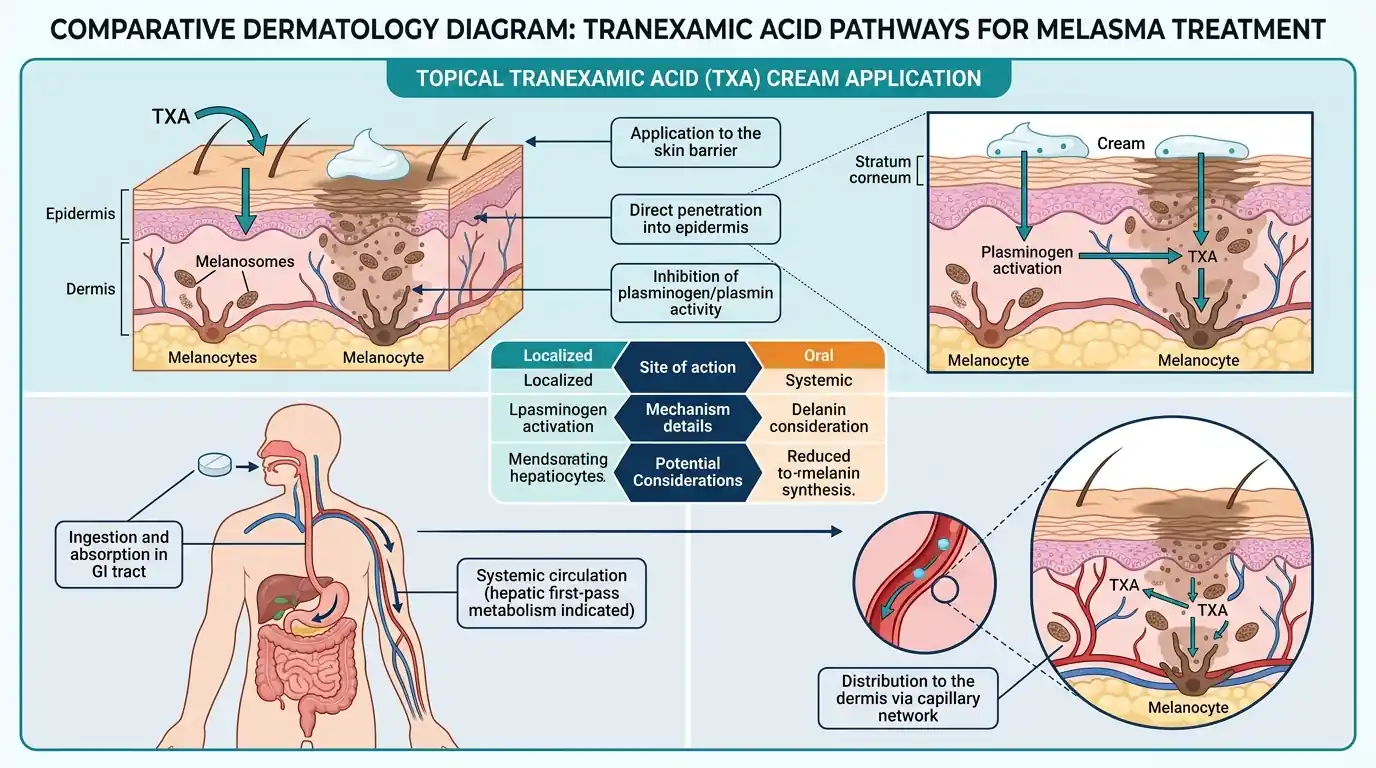
1. The Biochemical Cascade: How Tranexamic Acid Silences Melanocyte Stimulation
Historically utilized as an antifibrinolytic agent in trauma surgery and menorrhagia, tranexamic acid (trans-4-aminomethylcyclohexanecarboxylic acid, molecular weight 157.21 Da) entered aesthetic dermatology following incidental observations of skin lightening during systemic therapy. Unlike hydroquinone, resorcinol, or arbutin, TXA is not primarily a cytotoxic or direct catalytic tyrosinase inhibitor; rather, it functions upstream by extinguishing the neuro-vascular and inflammatory inflammatory cascade that perpetually signals melanocytes to synthesize eumelanin.
When epidermal keratinocytes are exposed to ultraviolet (UV) radiation or barrier disruption, they trigger elevated synthesis of plasminogen activator, which converts plasminogen into active plasmin. Plasmin exerts multifaceted pro-pigmentary effects across the dermal-epidermal junction:
TXA is a synthetic structural analogue of the amino acid lysine. It reversibly and competitively occupies the lysine-binding sites on plasminogen molecules, preventing them from docking onto keratinocyte cell surface receptors.
Free plasmin activates intracellular phospholipase A2, freeing arachidonic acid and accelerating prostaglandin E2 (PGE2) and leukotriene synthesis. By blocking plasmin formation, TXA halts the production of these key melanocyte-stimulating lipid autacoids.
Lesional melasma skin displays prominent telangiectasias and enlarged dermal microvasculature. TXA downregulates Vascular Endothelial Growth Factor (VEGF) and basic Fibroblast Growth Factor (bFGF), diminishing the dermal erythema and endothelial-derived stem cell factor (SCF) that fuel chronic pigmentation.
Dermal mast cell counts are significantly higher in elastotic melasma tissue. TXA reduces mast cell degranulation, curbing local histamine release and protecting the basement membrane from solar elastosis-mediated collapse.
By operating as an upstream paracrine circuit-breaker, tranexamic acid shuts down the communication lines between photo-damaged keratinocytes, vascular endothelial cells, mast cells, and basal melanocytes. To understand how water-soluble molecules navigate the stratum corneum alongside lipid phases, reference our fundamental guide on The Molecular Weight Hierarchy of Topical Actives.
2. Topical Bioavailability vs. Oral Pharmacokinetics
The therapeutic dilemma in modern aesthetic practices hinges on route of administration. Does applying a cosmetic serum formulated with 3% to 5% TXA deliver sufficient dermal concentration to quench deep melasma, or is systemic circulation necessary to reach hyperactive melanocytes and dilated subpapillary plexuses?
Topical Administration (3% to 5% Emulsions)
Tranexamic acid carries a molecular mass of 157 Da, well beneath the classical 500-Dalton molecular cutoff. However, TXA is a highly polar, hydrophilic zwitterion with an extremely low octanol-water partition coefficient (log P ≈ -1.6). This extreme hydrophilicity creates a substantial biophysical barrier: the hydrophobic lipid lamellae of the stratum corneum (rich in ceramides, cholesterol, and free fatty acids) resist passive transdermal flux.
Standard cosmetic serums achieve modest epidermal penetration, concentrating primarily in the upper stratum granulosum and spinosum. While this provides adequate suppression of keratinocyte-derived plasminogen activation in superficial epidermal melasma, penetration into the deeper papillary dermis—where abnormal telangiectatic vessels and mast cells reside—is limited unless paired with penetration enhancers (ethoxydiglycol, lecithin liposomes) or trans-epidermal micro-channeling such as fractional non-ablative lasers or RF Microneedling Technologies.
Oral Pharmacokinetics (250 mg Twice Daily)
In contrast, orally ingested tranexamic acid exhibits approximately 34% to 50% gastrointestinal bioavailability. Following ingestion of 250 mg, peak plasma concentrations (Cmax ≈ 4–5 mg/L) are attained within 2 to 3 hours. TXA distributes freely throughout extracellular fluids and enters cutaneous tissue via the dermal microcapillary system.
Systemic delivery achieves continuous, uniform perfusion of both the epidermal basal layer and the deep reticular dermis. This unrestricted biodistribution directly reaches the dermal vascular endothelial cells, shutting down VEGF expression and mast cell recruitment throughout the full architectural thickness of the skin—a feat topical application struggles to replicate in heavy dermal melasma.
| Pharmacokinetic Variable | Topical TXA (3% – 5%) | Low-Dose Oral TXA (250 mg BID) |
|---|---|---|
| Target Anatomical Depth | Epidermis (Stratum Spinosum/Basale) | Full Cutaneous Axis (Basale + Papillary/Reticular Dermis) |
| Vascular & Mast Cell Access | Low (Requires micro-channeling) | High (Direct perfusion via microcapillaries) |
| Typical Onset Velocity | 8 – 12 Weeks (Gradual clearance) | 4 – 8 Weeks (Rapid mMASI drop) |
| Mean mMASI Score Reduction | 22% – 38% reduction at 12 weeks | 49% – 65% reduction at 12 weeks |
| Systemic Thromboembolic Risk | Absolute Zero (Negligible plasma flux) | Extremely low in screened cohorts; requires medical clearance |
| Ideal Clinical Candidate | Mild/epidermal melasma, pregnancy/lactation, thrombotic risk | Recalcitrant, mixed/dermal melasma, prominent vascularity |
3. Clinical Trial Evidence: mMASI Reductions & Recurrence Realities
The gold standard in quantifying melasma severity is the modified Melasma Area and Severity Index (mMASI), which objectively evaluates darkness, homogeneity, and facial surface area involvement.
In a pivotal double-blind, randomized, placebo-controlled trial conducted in Australia, patients with moderate-to-severe recalcitrant melasma were administered oral tranexamic acid (250 mg twice daily) or placebo for 12 weeks. At the trial endpoint, the oral TXA cohort demonstrated a 49% reduction in mMASI compared to only 18% in the placebo cohort. Furthermore, quality-of-life scores (MELASQoL) improved dramatically, with photographic clearing visible as early as week 4.
Recent 2024 network meta-analyses compiling over 30 randomized controlled trials confirmed that oral TXA combined with routine topical depigmenting regimens (hydroquinone, retinoids, or azelaic acid) produced the greatest statistically significant MASI reductions of any non-surgical therapeutic modality.
4. Safety, Thromboembolic Risk & Dermatologist Protocols
Because tranexamic acid blocks fibrinolysis by preventing plasmin from dissolving fibrin clots, the potential risk of systemic thromboembolism—specifically deep vein thrombosis (DVT), pulmonary embolism (PE), and ischemic stroke—dominates clinical risk stratification.
In hematologic and surgical settings, TXA is prescribed at doses between 3,000 mg and 4,000 mg daily. In aesthetic dermatology, the standard protocol employs an ultra-low dose of 250 mg twice daily (500 mg total daily dose)—less than one-sixth of the anti-hemorrhagic dose. In extensive retrospective reviews encompassing thousands of melasma patients treated with this low-dose regimen, the incidence of venous thromboembolism was comparable to the baseline population risk. Mild adverse events occurred in under 8% of patients, primarily comprising transient hypomenorrhea (lighter menstrual flow), dyspepsia, or mild cephalalgia.
Strict Clinical Contraindications for Oral TXA
- • Personal or immediate family history of venous or arterial thrombosis (DVT, PE, cerebrovascular accident).
- • Diagnosed hereditary thrombophilias (Factor V Leiden mutation, Prothrombin G20210A, Protein C/S deficiency, Antithrombin III deficiency).
- • Concurrent administration of combined oral contraceptives (containing ethinylestradiol) or systemic hormone replacement therapy.
- • Active malignancy, heavy tobacco use in patients over 35 years of age, or severe chronic kidney disease (due to renal excretion pathways).
For patients exhibiting these contraindications, topical TXA at 3% to 5% serves as an exceptionally safe, non-systemic alternative with zero thrombotic liability. When deeper pigment clearance is desired without oral medications, clinicians frequently combine topical TXA with in-clinic procedures like TCA Peels with Strict PIH Protocols or non-ablative laser passes to dramatically enhance trans-epidermal active flux.
5. The Atelier Multi-Pathway Layering Protocol
To conquer refractory hyperpigmentation, formulators must attack melanin synthesis from complementary biochemical angles. Relying on a single active allows melanocytes to circumvent inhibition through secondary compensatory pathways.
- Morning Vascular & Antioxidant Quench: Apply 15% L-Ascorbic Acid (pH <3.5) to clean, dry skin. Wait 60 seconds to allow the acid mantle to stabilize. Follow immediately with a lightweight 3% Tranexamic Acid and 2% Niacinamide serum to quench UV-induced plasmin formation and halt melanosome transfer. Cap with a 20% Non-Nano Zinc Oxide SPF to block both UV and visible blue light, a known inducer of persistent pigment in Fitzpatrick types III–VI.
- Evening Cellular Renewal: On alternating evenings, introduce micro-encapsulated Retinaldehyde or direct-binding Hydroxypinacolone Retinoate (HPR) to accelerate keratinocyte shedding and melanosome clearance, followed by an azelaic acid or tranexamic acid emulsion to sustain anti-inflammatory control throughout the nocturnal repair phase.
- Barrier Reinforcement: Seal the regimen with an emulsion containing ceramides, free fatty acids, and cholesterol in a biomimetic ratio to prevent subclinical transepidermal water loss from triggering secondary melanogenic inflammatory signals.
For complete clinical sequencing protocols, explore our in-depth analysis of In-Office Skin Remodeling and Aesthetic Procedures.
Frequently Asked Questions: Tranexamic Acid in Aesthetic Practice
How long does it take for tranexamic acid to show visible improvements in melasma?
Low-dose oral tranexamic acid (250 mg twice daily) typically produces measurable mMASI score reductions within 4 to 8 weeks, with maximal therapeutic clearance observed between weeks 8 and 12. Topical formulations at 3% to 5% concentration exhibit a more gradual onset, requiring 8 to 12 weeks of continuous twice-daily application to demonstrate statistically significant pigment clearance.
How does tranexamic acid inhibit melanin production without being a direct bleaching agent?
Tranexamic acid is a synthetic lysine analogue that reversibly binds lysine-binding sites on plasminogen. By blocking ultraviolet-induced plasmin formation in keratinocytes, it halts the intracellular release of arachidonic acid, suppresses prostaglandin E2 (PGE2) and leukotrienes, downregulates vascular endothelial growth factor (VEGF), and prevents paracrine signaling that triggers melanocyte tyrosinase activation.
What are the primary contraindications for oral tranexamic acid in aesthetic dermatology?
Oral tranexamic acid is contraindicated in patients with an active or previous history of venous or arterial thromboembolism (deep vein thrombosis, pulmonary embolism, stroke, or myocardial infarction), known thrombophilic coagulopathies (such as Factor V Leiden or Antithrombin III deficiency), active cardiovascular disease, severe renal impairment, or concurrent use of high-thrombotic-risk estrogen therapies.
Can topical tranexamic acid be layered alongside other brightening actives like hydroquinone or vitamin C?
Yes. Because tranexamic acid works via anti-plasmin and vascular modulation pathways rather than direct competitive tyrosinase inhibition, it synergizes well with direct tyrosinase blockers like hydroquinone, cysteamine, azelaic acid, and pure L-ascorbic acid, as well as cell turnover accelerators such as retinoids.