Celebrity Skincare Brands Deconstructed: Active Percentages vs Formula Realities
From glazed donut glazing serums to minimalist nine-step monoliths, celebrity-founded skincare lines dominate social feeds and retail shelves. But behind custom-molded silicone packaging and high-wattage founders lies contract chemistry. An aesthetic chemist pulls back the veil on INCI 1% thresholds, parts-per-million peptide mechanics, and marketing fairy dusting.
Laboratory Audit Summary: Reading Past The Celebrity Halo
- 1. The Regulatory 1% Line: Under FDA 21 CFR 701.3, ingredients above 1% must appear in strict descending order of weight. Below 1%, manufacturers can order ingredients alphabetically or strategically, obscuring whether an active is present at an effective dose or as marketing window dressing.
- 2. The Reality of Fairy Dusting: Adding 0.05% of an expensive botanical extract or peptide complex satisfies legal truth-in-advertising guidelines for front-label claims, while inexpensive glycerin and silicones provide 95% of the tactile hydration.
- 3. Peptides Work in PPM, Not Percentages: Biomimetic signal peptides (palmitoyl tripeptide-1, copper peptides) operate biologically at parts-per-million (3–15 ppm). An active appearing near the end of a label is not necessarily useless—formulation vehicle and penetration enhancers matter far more than sheer quantity.
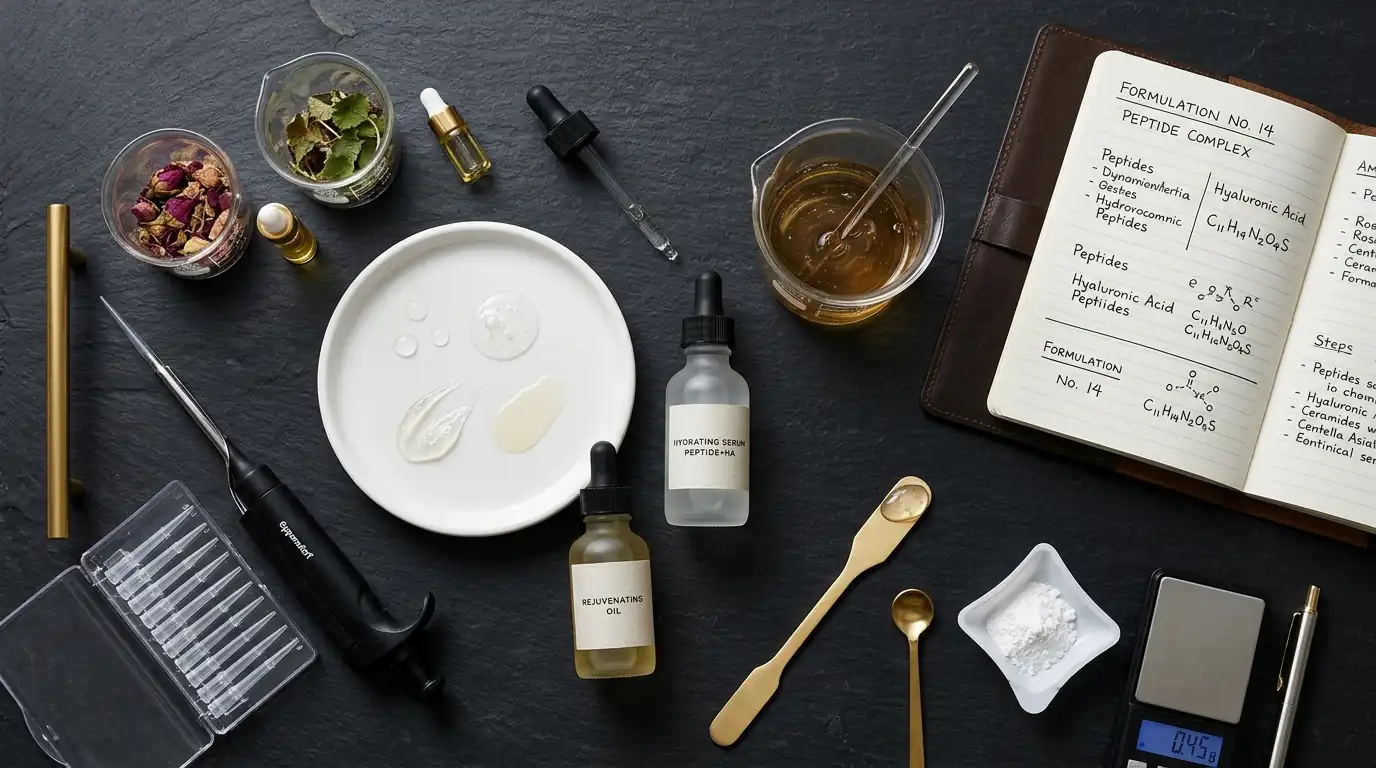
1. The Celebrity Skincare Boom: Licensing vs. Contract Chemistry
In the early 2000s, celebrity cosmetic branding was defined by fragrance licensing: a performer signed a name-use agreement with a legacy fragrance conglomerate, collected a royalty check, and appeared in print advertisements. Today, celebrity commercial architecture has transformed into vertically integrated beauty incubators.
From Hailey Bieber's Rhode and Kim Kardashian's SKKN to Rihanna's Fenty Skin and Jessica Alba's Honest Beauty, public figures are presented as lead product developers and aesthetic visionaries. But how are these products genuinely formulated?
With rare exceptions, celebrity brands do not construct proprietary multi-million-dollar formulation laboratories or employ in-house basic science teams. Instead, they partner with established Original Equipment Manufacturers (OEM) and Original Design Manufacturers (ODM)—such as Seed Beauty, KDC/One, or Intercos. These industrial contract facilities maintain extensive libraries of pre-tested, stable "base chassis" (emulsions, gels, surfactant blends). The celebrity and their marketing team select a chassis, adjust sensory fragrance and texture modifiers, select "hero" story ingredients, and package the formula in custom-tooled components.
Understanding this supply chain is critical: the bulk liquid inside a \$38 to \$85 luxury celebrity serum typically costs between \$1.20 and \$3.50 in raw chemical ingredients. The remaining retail price pays for custom industrial molds, brand equity margins, and high-frequency influencer gifting.
2. How a Cosmetic Chemist Reads an INCI Label: The 1% Rule
To evaluate any cosmetic formula objectively, one must look past the front-facing packaging claims and examine the International Nomenclature of Cosmetic Ingredients (INCI) declaration on the back panel.
In the United States, cosmetic labeling is governed by the Food and Drug Administration under 21 CFR 701.3. The regulation enforces a strict mathematical hierarchy:
Every ingredient included at a concentration greater than 1.0% by weight (w/w) MUST be listed in precise, descending order of predominance. The first three to six ingredients (typically Water, Glycerin, Butylene Glycol, Caprylic/Capric Triglyceride, Dimethicone) constitute 85% to 95% of the total formula volume.
Any ingredient present at or below 1.0% may be listed in any order whatsoever. A manufacturer can place an active present at 0.001% directly alongside an ingredient at 0.99%, allowing marketing teams to push exotic botanicals higher up the list to appear more prominent.
Locating the Invisible "1% Benchmark" in the Wild
Because regulations do not print a physical line on the carton, cosmetic chemists look for formulation benchmark indicators—ingredients whose maximum use levels are strictly bounded by stability or toxicology:
- Phenoxyethanol: The most ubiquitous broad-spectrum preservative in clean and modern skincare. Legally capped at 1.0% maximum in the European Union and rarely formulated above 0.8% in North America. Once you spot Phenoxyethanol, every ingredient listed after it is virtually guaranteed to be at sub-1% concentration.
- Xanthan Gum / Carbomer: Rheology modifiers and gelling agents. Typically formulated between 0.2% and 0.5%. Formulating carbomer above 1% results in an un-spreadable, rubbery brick.
- Disodium EDTA: A heavy-metal chelating agent added to prevent oxidation and stabilize emulsions. Almost universally dosed between 0.05% and 0.2%.
3. The "Fairy Dusting" Phenomenon: Marketing Claims vs. Clinical Dosing
Fairy dusting (also known in cosmetic manufacturing as "angel dusting") is the deliberate practice of adding micro-doses of an expensive, clinically tested raw material solely to legally claim its presence and benefits on packaging, while relying on cheap base ingredients to do the actual mechanical work.
However, a crucial nuance must be recognized: not all low-concentration ingredients are fairy-dusted. The clinical effectiveness of an active depends entirely on its biological mechanism of action and molecular potency:
| Active Ingredient | Clinical Efficacy Threshold | Common Celebrity Reality | Formulation Chemist Verdict |
|---|---|---|---|
| Niacinamide (Vitamin B3) | 2.0% – 5.0% (Barrier & Pigment) | 0.5% (Token) or 10%+ (Irritant overkill) | Human RCTs (PMID: 24033822) confirm 5% reduces spots; 10% risks flushing. |
| Signal Peptides (Matrixyl 3000) | 3 – 15 ppm (Pure Active Peptide) | Present below 1% line in trade blends | Legitimate: Peptides signal cellular receptors at parts-per-million; high % is neither needed nor stable. |
| L-Ascorbic Acid (Pure Vitamin C) | 10.0% – 20.0% at pH < 3.5 | Replaced by 1% oil-soluble derivatives | Derivatives (Tetrahexyldecyl Ascorbate) offer stability, but have thinner clinical evidence for in vivo conversion. |
| Hyaluronic Acid (Multi-weight) | 0.2% – 1.0% (Higher creates tack) | Advertised as "2% Solution" (98% water) | Marketing deception: 2% of a pre-diluted stock raw material yields only 0.02% pure active sodium hyaluronate. |
The "Raw Material Solution" Illusion
Consumers frequently read front labels touting "5% Peptide Complex" or "2% Hyaluronic Acid" and assume the bottle contains 5 grams of pure peptide molecules per 100 grams. In cosmetic manufacturing, raw material suppliers sell peptides pre-dissolved in glycerin, water, and butylene glycol at dilutions of 100 to 500 ppm. When a brand adds 3% of this trade solution into their vat, the actual active concentration of pure peptide in the finished product is only 0.0003% to 0.0015%. While biologically active at this ppm level, advertising it as "5%" is a masterclass in regulatory marketing arbitrage.
4. Brand Audits Under the Microscope: Rhode, SKKN & Fenty Skin
Let us examine three prominent celebrity portfolios from the perspective of an independent formulation lab:
Rhode by Hailey Bieber: Peptide Glazing Fluid & BRC
Formulation Grade: B+The Chemist's Audit: Rhode's formulations succeed not because of exotic proprietary inventions, but because of sound classical cosmetic foundations. The Peptide Glazing Fluid relies on a light polyacrylate crosspolymer gel vehicle loaded with glycerin, propanediol, and squalane to achieve its signature refractive optical sheen. It incorporates palmitoyl tripeptide-1 and palmitoyl tetrapeptide-7 alongside niacinamide.
Verdict: Free of volatile essential oils, fragrance, and irritating solvent alcohols. While the "peptide glaze" is largely an optical silicone-humectant reflection, the formulas are genuinely barrier-supportive, non-comedogenic, and reasonably priced within the market (\$30–\$35 range).
SKKN by Kim Kardashian: The 9-Step Monolith
Formulation Grade: CThe Chemist's Audit: Launched with architectural concrete-style refillable vessels and a \$575 full-system price tag, SKKN promotes active redundancy. Stacking an enzymatic exfoliator, a glycolic toner, a hyaluronic serum, an oil-drops elixir, and a rich night cream encourages multi-active barrier fatigue in everyday consumers.
Verdict: Several products include synthetic fragrance, which is contraindicated for reactive barrier conditions. While the lipid-rich night cream features squalane and shea butter, the astronomical pricing reflects industrial brutalist packaging design and celebrity positioning rather than novel dermal bio-actives.
Fenty Skin by Rihanna: Fat Water & Hydra Vizor
Formulation Grade: BThe Chemist's Audit: Fat Water pioneered the viscous toner-serum hybrid format, using carbomers and hydroxyethylcellulose to create a thick, cushiony liquid that prevents evaporative dripping. It includes functional levels of niacinamide and Barbados cherry extract. Hydra Vizor is a chemical SPF moisturizer engineered with excellent invisible blending across Fitzpatrick skin types IV through VI without chalky white casts.
Verdict: Exceptional sensory aesthetics and inclusive photoprotection engineering. However, the heavy presence of added fragrance components limits suitability for compromised, rosacea-prone, or perioral dermatitis-afflicted skin types.
5. Packaging Architecture & Active Longevity: The Science of Containment
When evaluating cosmeceutical integrity, the container is not mere aesthetics—it is a functional drug-delivery vessel. A brilliant formulation packaged in the wrong bottle will oxidize and degrade within 30 days of unsealing.
The Dropper Bottle Hazard
Dropper bottles are beloved in social media videos for aesthetic application. But every time the rubber pipette is withdrawn, atmospheric air enters the bottle. For light- and oxygen-sensitive actives—such as pure L-ascorbic acid, retinol, and unsaturated botanical lipids—this constant exposure drives free radical lipid peroxidation, turning active serums yellow or brown and forming irritating degradation byproducts.
Airless Opaque Vacuum Pumps
In contrast, dual-chamber airless vacuum pumps use an internal rising piston to evacuate product without introducing outside oxygen. Combined with opaque, UV-blocking polymer shells, airless packaging extends the stability of delicate antioxidant cascades, minimizes the necessity for harsh preservative loads, and guarantees consistent active potency down to the final dose.
6. Frequently Asked Questions: Celebrity Formulations & INCI Realities
How can I tell if an ingredient is under the 1% line? ↓
Scan the ingredient list for standard anchor preservatives: Phenoxyethanol, Ethylhexylglycerin, Potassium Sorbate, or Sodium Benzoate. Because these preservatives are capped between 0.5% and 1.0% for safety and regulatory reasons, any botanical extract, peptide, or luxury oil listed after them is virtually certain to be present at less than 1%.
Are expensive skincare lines always superior to drugstore equivalents? ↓
No. Modern cosmetic chemistry is largely democratic: both \$12 drugstore serums and \$120 celebrity creams source raw materials from the same global chemical suppliers (BASF, Croda, DSM, Ashland). Price disparities reflect brand positioning, packaging tooling, and retail margins rather than fundamental differences in raw chemical purity.
What is the difference between active ingredients and functional ingredients? ↓
Active ingredients (like niacinamide, peptides, retinol) provide targeted cellular, biological, or physiological outcomes on the skin. Functional ingredients (emulsifiers, thickeners, chelators, preservatives) make up the vehicle: they hold water and oil together in a stable suspension, control viscosity, and prevent microbial contamination. A great formula requires high-purity actives housed in an biocompatible functional vehicle.
Why do some serums pill when layered with makeup? ↓
Pilling occurs when high-molecular-weight film-forming polymers (such as carbomers, xanthan gum, or heavy silicones like dimethicone crosspolymer) fail to absorb into the stratum corneum and dry on the skin surface. When an oil-based foundation or physical friction is applied on top, these surface polymers shear and roll up into visible flakes.
Regulatory Standards & Peer-Reviewed Literature
- U.S. Food & Drug Administration: Cosmetics Labeling Guide & Declaration of Ingredients. 21 CFR 701.3. FDA Guidelines.
- Journal of Clinical & Aesthetic Dermatology: A randomized, double-blind, vehicle-controlled evaluation of topical niacinamide combinations in facial hyperpigmentation. J Clin Aesthet Dermatol. 2013. PMID: 24033822.
- Cosmetic Ingredient Review (CIR): Safety Assessment of Palmitoyl Oligopeptides as Used in Cosmetics. International Journal of Toxicology. CIR Reports 2012 & 2014. CIR Dossier.
- Biomolecules & Therapeutics / Niacinamide: Mechanisms of action and clinical efficacy of topical niacinamide in cosmetic dermatology. PMCID: PMC8389214. PMC Article.
- Dermatologic Surgery: Topical L-Ascorbic Acid: Percutaneous absorption studies, pH requirements, and vehicle stability. Dermatol Surg. PMID: 11207686.